LMZ System 1000 boots as the LMZ site's machine. This issue gives it a site of its own and names of its own.
LMZ System 1000 · subnet 376 · COLDBOOT-LISPM-1
I'm back. Last time I booted System 100 as MIT-LISPM-1.
LMZ System 1000's pack calls me LISPM-1, at the LMZ site. Today I get my own names.
What changes by page 12
         before     after
site     LMZ        COLDBOOT
CADR     LISPM-1    COLDBOOT-LISPM-1
OZ       OZ         COLDBOOT-OZ
pack     LISPM-1    COLDBOOT-LISPM-1
band     LOD1       LOD2
The addresses stay as they are: OZ at 177200, the CADR at 177201.
- CASTNew crewp.03
- EP.1LMZ System 1000p.04
- EP.2Subnet 376p.05
- EP.3The pack as it comesp.07
- EP.4Four filesp.09
- EP.5New name, new bandp.11
- ENDLinks and docsp.12
Issue 01's crew: muir, the CADR in software, and ozd, OZ as a daemon. This issue, the software on the pack joins them.
The system: MIT's Lisp Machine software, made usable today.
- From
- MIT's System 99.32, as LM-3 brought it up as System 100
- Release
- LMZ System 1000, 17 September 2026
- Built by
- itself: the band on its pack was compiled by LMZ System 1000 from its own sources
- Licence
- GNU AGPL 3.0 or later
LMZ is what I run this time.
And I serve its sources at /sys.
LMZ's first release is two files on GitHub: a disk pack, and the sources its band was built from.
$ mkdir -p ~/lmz && cd ~/lmz
$ R=https://github.com/metebalci/lmz/releases/download/lmz-1000
$ curl -LO $R/lmz-1000-pack.img.gz
$ curl -LO $R/lmz-1000-sys.tar.gz
$ gunzip -k lmz-1000-pack.img.gz
$ tar -xzf lmz-1000-sys.tar.gz
What is in ~/lmz now
- Pack
- lmz-1000-pack.img, named LISPM-1: microcode 323 in MCR1, the band in LOD1
- sys/
- lmz-1000/sys, the system's sources
- site/
- lmz-1000/site, the LMZ site the band was built with: an example to copy and readdress
A site of its own needs addresses that belong to nobody else. chaosnet.net keeps one subnet for that.
“one subnet has been reserved as a private, non-routed subnet. … This is similar to the IP Private networks such as 10.x.y.z or 192.168.x.y.”
“That subnet is 376 (octal, = 254 decimal) which gives addresses 177001-177377 octal.”
376
An address is sixteen bits in octal, the subnet and then the host. 177201 is subnet 376, host 201.
Today the Global Chaosnet joins Chaosnets over modern protocols. Packets from subnet 376 are not sent to other subnets, so they never reach it.
The LMZ site already lives on 376: OZ is 177200, and a machine LISPM-n is 177200 plus n. So I am 177201.
In the ozd directory. OZ serves ~/lispm, where the new site will go, and LMZ's sources at /sys. It already answers to the names it will have.
$ mkdir -p ~/lispm
$ target/release/ozd --address 177200 \
    --name COLDBOOT-OZ,OZ,system=UNIX \
    --root ~/lispm \
    --root sys=$HOME/lmz/lmz-1000/sys,ro \
    --host 177201,COLDBOOT-LISPM-1,LM1,system=LISPM \
    --peer 177201@127.0.0.1:42043
In the muir directory. Start the CADR at 177201 on the pack.
$ target/release/muir --micro \
    --disk-pack ~/lmz/lmz-1000-pack.img \
    --chaos-address 177201 --chaos-udp 42043 \
    --chaos-udp-peer 177200@127.0.0.1:42042 \
    --terminal 0.0.0.0:5900
--micro is muir's fastest engine, and the machine's clock runs fast with it. --pace holds the machine to its own speed.
Same ports as issue 01: I listen on 42042, and the CADR on 42043.
muir writes to the pack as the machine does. Keep lmz-1000-pack.img.gz if you want the original back.
No date to type: the band's host table already has OZ at 177200, and OZ tells it the time. It says:
 1
2
1
2
- 1band 1 of LISPM-1. The pack is named after its machine, LISPM-1.
- 2LMZ Lisp Machine One. The band's site is LMZ, and it calls the machine Lisp Machine One.
(print-disk-label) lists the pack's partitions. The star marks the current band.


LOD1, "Exp 1000", is current. LOD2 to LOD4 are empty.
A band carries the site it was saved with: the site's options, its host table, and where its machines are.
So a new name needs new site files. Where does the band look for them?
It reads them from SYS: SITE; and LMZ's sys.translations sends that to OZ:
("SITE;" "//site//")
That is /site/ on OZ. Our OZ serves ~/lispm there, which has no site/ yet.
So we write our own four files into /site/, on the Lisp Machine itself.
 1
2
1
2
- 1(login 'lispm). Log in on OZ, the associated machine.
- 2(fs:create-directory …). Make /site/ on OZ.
Press no Return: the Listener runs a form at its closing parenthesis. In this syntax a slash quotes the next character, so each / in a path is typed //.
Now open ZMACS on the first site file.
(ed "oz: //site//site.lisp")

In ZMACS, type each file and save it with Control-X Control-S. Control-X Control-F and a name, such as hosts.text, opens the next one in /site/.
site.lisp: the site's name and options. :TIMEZONE is hours earlier than GMT, so Switzerland is -1.
;;;-*- Mode:LISP; Package:SYSTEM-INTERNALS; Base:8 -*-
(DEFSITE :COLDBOOT
  (:SYS-LOGIN-NAME "LISPM")
  (:SYS-LOGIN-PASSWORD "LISPM")
  (:TIMEZONE -1)
  (:CHAOS-FILE-SERVER-HOSTS '("COLDBOOT-OZ"))
  (:CHAOS-TIME-SERVER-HOSTS '("COLDBOOT-OZ"))
  (:CHAOS-HOST-TABLE-SERVER-HOSTS '("COLDBOOT-OZ")))
hosts.text: the two hosts, their addresses and nicknames.
;;; -*- Mode:Text -*-
HOST COLDBOOT-OZ,      CHAOS 177200,SERVER,UNIX,UNIX,[OZ]
HOST COLDBOOT-LISPM-1, CHAOS 177201,USER,LISPM,CADR,[LM1]
lmlocs.lisp: where the CADR is, and its associated machine.
;;; -*- Mode:Lisp; Package:SYSTEM-INTERNALS; Base:10. -*-
(DEFCONST MACHINE-LOCATION-ALIST
 '(("COLDBOOT-LISPM-1" "Lisp Machine One"
    "Cold Boot" (COLDBOOT 1) "OZ")))
sys.translations: where SYS: files live on OZ.
;;;-*- Mode:LISP; Package:FS; Base:10 -*-
(SET-LOGICAL-PATHNAME-HOST "SYS"
  :PHYSICAL-HOST "COLDBOOT-OZ"
  :TRANSLATIONS '(("SITE;" "//site//")
                  ("*; *; *;" "//sys//*//*//*//")
                  ("*; *;" "//sys//*//*//")
                  ("*;" "//sys//*//")))
Back in the Listener (SYSTEM L), (make-system 'site :compile) builds the site. It asks before each step: type y.
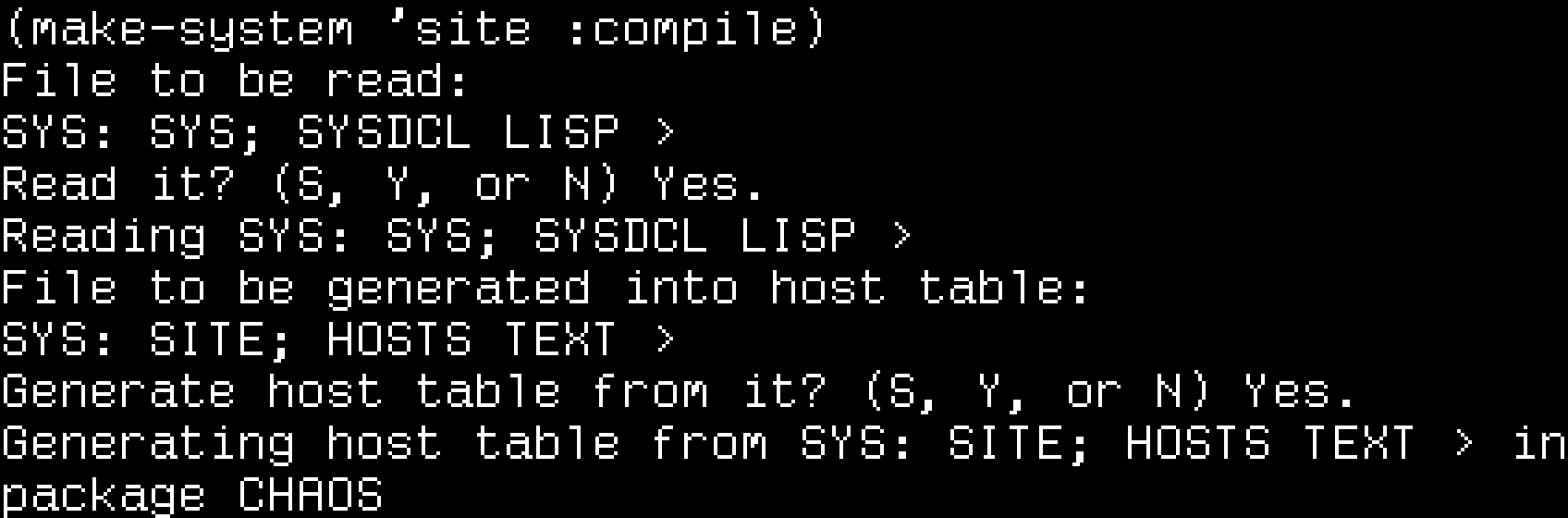
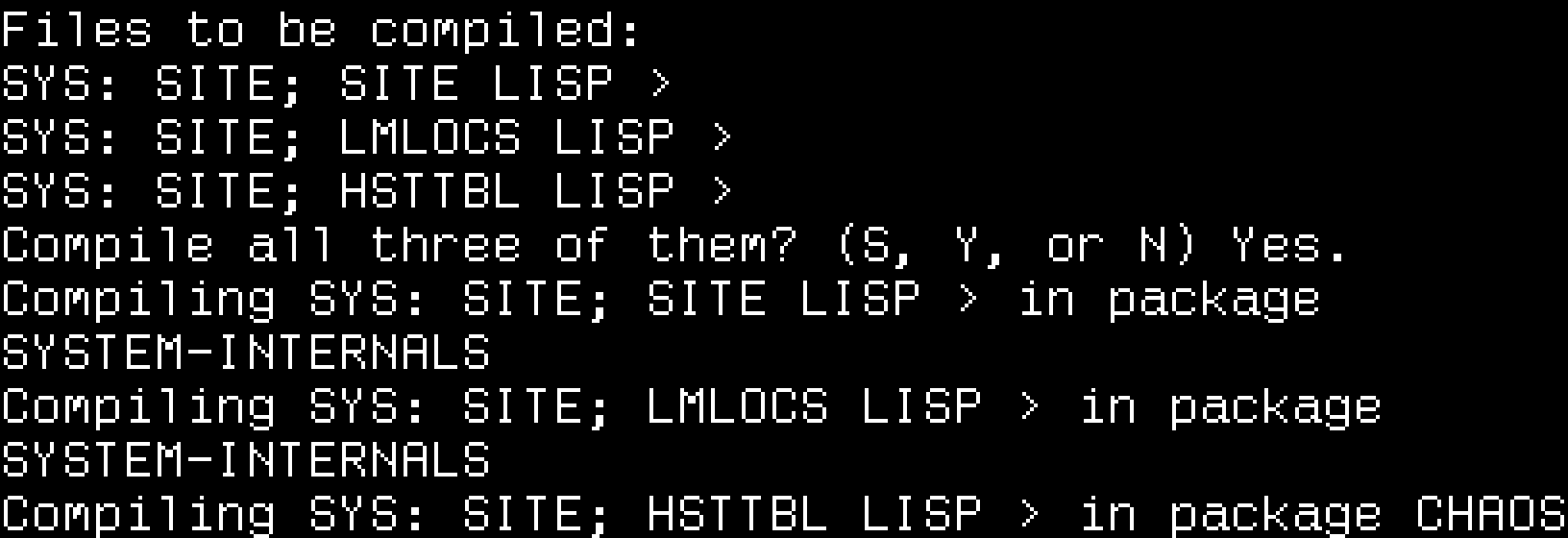
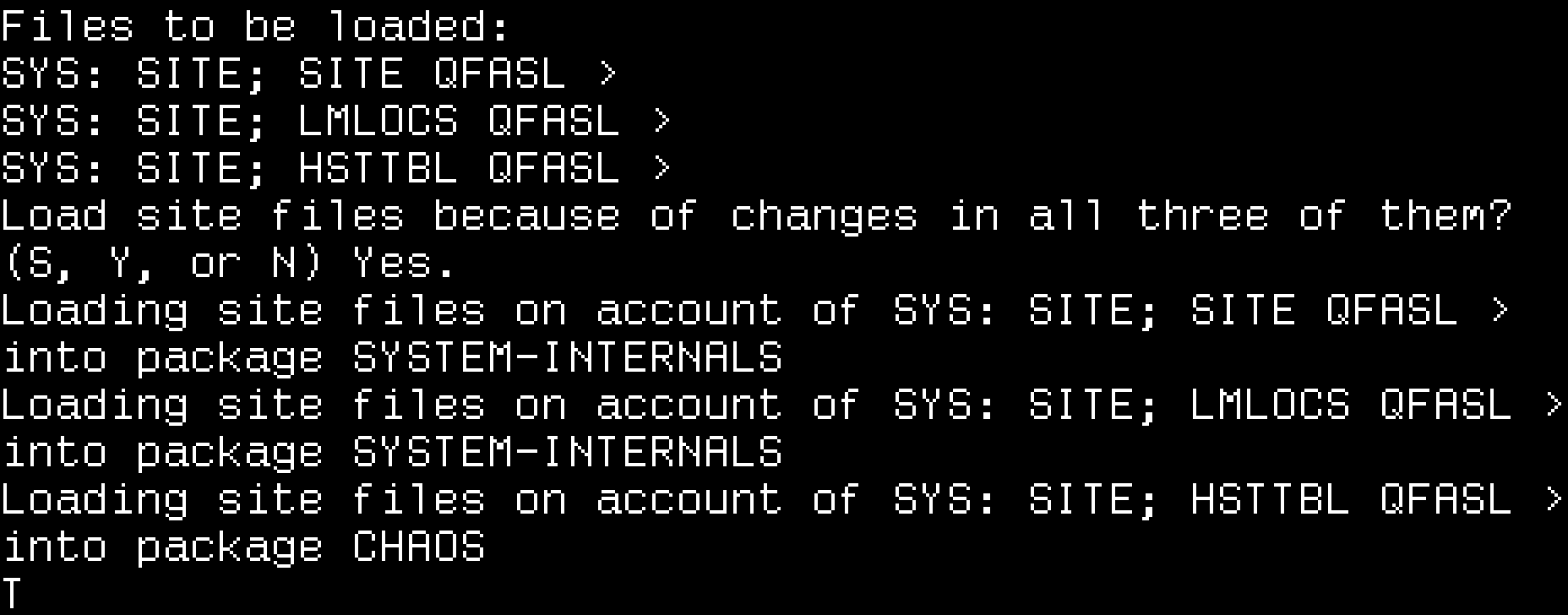
T, and I am COLDBOOT-LISPM-1 already. The pack still says LISPM-1.
Name the pack. The name goes into the disk label at once.
(si:set-pack-name "COLDBOOT-LISPM-1")
"COLDBOOT-LISPM-1"
Save this world into LOD2, which is empty.
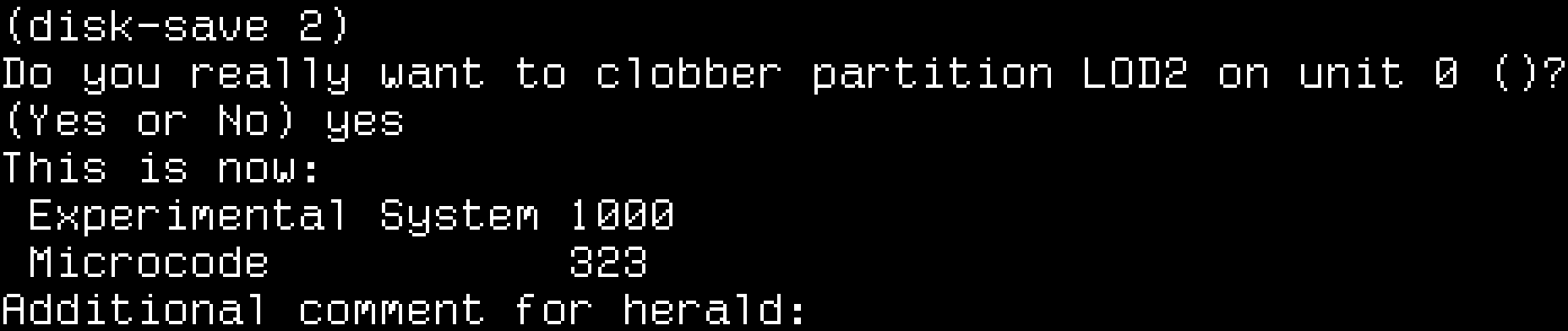
Type yes and Return, then Return again for no comment. The machine saves band 2 and boots it.
I booted band 2, but the pack still boots band 1. One more form.


Cold boot the pack again. It boots band 2, with my own names.

- muir
- github.com/metebalci/muir
- ozd
- github.com/metebalci/ozd
- LMZ
- github.com/metebalci/lmz
- LM-3
- tumbleweed.nu/lm-3, which brought System 99.32 up as System 100
- Subnet 376
- chaosnet.net/local
- Lisp Machine Manual
- Site options, and Updating Site Information. tumbleweed.nu/r/lm-3/uv/chinual.html
- Chaosnet
- David A. Moon. MIT AI Memo 628, 1981. hdl.handle.net/1721.1/6353
TO BE CONTINUED
Cold Boot is made by Mete Balci, with help from Claude Opus 5 and OpenAI GPT-6 Astra. Set in Dela Gothic One, Zen Maru Gothic and IBM Plex Mono, in two colours: black and fluorescent pink. The screens are from muir. Send feedback to coldboot@metebalci.com.
© 2026 Mete Balci. Licensed under CC BY-SA 4.0.